Pool Builder FAQs — Boise & Treasure Valley
Everything you want to know about building and owning a pool in Southern Idaho — answered by builders with 45+ years of local experience.
Everything you want to know about building and owning a pool in Southern Idaho — answered by builders with 45+ years of local experience.
From first-time pool buyers in Boise and Meridian to experienced pool owners in Twin Falls and Magic Valley — these are the questions we hear most. Don't see yours? Call or text us directly.
A typical gunite or shotcrete pool build in Boise, Meridian, Nampa, or anywhere in Treasure Valley takes 3 to 5 months from permit approval to final inspection. This timeline depends on the complexity of your design, weather conditions, and the permitting process in your specific city — Boise, Meridian, Nampa, Caldwell, and Eagle each have their own timelines.
We handle all permitting on your behalf and keep you updated at every stage so there are no surprises. Scott and Cary are personally involved throughout the entire build.
Yes — all cities in Treasure Valley and Magic Valley require building permits for inground pool construction. Requirements vary by municipality: Boise, Meridian, Nampa, Caldwell, Eagle, Kuna, Star, Twin Falls, and Jerome each have their own permit applications, plan review process, and inspection stages.
Universal Pools handles all permit applications on your behalf. We know the local processes and have established relationships with municipal inspection departments across Southern Idaho, which helps keep your project moving without unnecessary delays.
Owner-assisted pool construction is a partnership model where you take on some of the non-licensed work yourself — under our expert guidance — to reduce your overall project cost without compromising on quality or safety.
You might handle things like landscaping, cleanup, painting, and general prep. Universal Pools manages everything that requires a licensed contractor: excavation, steel, gunite, plumbing, electrical, equipment, and final inspection. We offer owner-assisted builds throughout Boise, Meridian, Nampa, Caldwell, Eagle, Kuna, and all of Treasure Valley and Magic Valley.
The most important things to verify: Idaho contractor's license (check at the Idaho Division of Building Safety), proof of insurance, and real local references you can actually call. Ask how long they've been building pools in Idaho specifically — our soil conditions, climate, and local permit requirements are things that experience here really matters for.
Universal Pools holds Idaho license RCE-35911 and has been building pools in Idaho since 1979. Scott and Cary are on every job personally — you're not dealing with a franchise or a subcontracted crew.
Both are concrete-based pool construction methods applied pneumatically (under air pressure) over a steel-reinforced framework. The difference is in how the concrete is delivered: gunite uses a dry mix where water is added at the nozzle, while shotcrete uses a pre-mixed wet concrete that is sprayed into place.
Both produce an equally strong, durable shell when applied by an experienced crew. The terms are often used interchangeably in the industry, and both are vastly superior to other pool types for Idaho's climate and soil conditions.
Yes — pool remodeling and large-scale repairs are a significant part of what we do. We handle replastering, resurfacing, tile and coping replacement, deck resurfacing, equipment upgrades, structural repairs, and full pool renovations throughout Boise, Meridian, Nampa, Eagle, Twin Falls, and all of Southern Idaho.
If your pool is aging or showing its age, we can assess it honestly and recommend the most effective path forward. Sometimes a targeted repair is all that's needed; sometimes a full renovation makes more sense. We'll give you a straight answer either way.
Gunite and shotcrete pools are the best choice for Idaho, hands down. Idaho's freeze-thaw cycles — which can be extreme across Treasure Valley and Magic Valley — put significant stress on pool shells throughout the year. Concrete-based pools are built to handle that movement far better than prefabricated alternatives.
They also offer complete flexibility in shape, size, and depth. A properly built gunite pool in Idaho can last 50+ years with appropriate maintenance — which is exactly why we've built them exclusively for four decades.
If you don't plan to use your pool year-round, yes — absolutely winterize it. A pool that is not properly winterized must have the pump running most of the winter to prevent freezing. If the pump stops — due to a power outage, mechanical failure, or any other reason — the water in the pool equipment and underground piping will freeze. Freeze damage repair bills can easily run into the thousands of dollars.
Your builder should construct the pool specifically to make winterizing straightforward — including proper plumbing layout and drain provisions. A proper fall closing and spring opening costs far less than one freeze event. We build every pool with Idaho winters in mind.
Soil conditions across Treasure Valley and Magic Valley vary significantly — from rocky ground in the Boise foothills to expansive clay soils near river corridors in Nampa, Caldwell, and the lower valley. Soil type directly affects excavation methods, the depth and configuration of steel reinforcement, drainage system requirements, and how the pool shell needs to be engineered.
Scott Pahl has 45+ years of experience working with Idaho soils specifically. This local knowledge is one of the most important advantages of hiring an experienced Idaho pool builder rather than an out-of-state contractor who has never dealt with our specific conditions.
Yes. Universal Pools serves Magic Valley including Twin Falls, Jerome, Burley, Buhl, Gooding, Filer, Wendell, Rupert, and surrounding communities — in addition to all of Treasure Valley. If you're in Southern Idaho and wondering whether we serve your area, the answer is almost certainly yes. Give us a call and we'll confirm.
Most pool equipment is rated for outdoor installation and doesn't require an enclosure. It should not be subjected to sprinkler spray or water runoff from a roof. In Idaho — where significant snowfall can occur — an enclosure is worth considering, especially if you plan to operate the pool year-round.
If you do enclose your equipment, each piece has specific requirements for service clearances, ventilation, combustion air, and venting that must be followed per manufacturer specs and local code. We'll walk you through the best setup for your specific situation.
Chlorine has two jobs in your pool: sanitation (killing bacteria and pathogens) and oxidation (breaking down organic material). Understanding this makes chlorine much easier to manage. When you smell a strong, pungent chlorine odor or the water looks dull, it's usually chloramines or a pH imbalance — and the pool actually needs more chlorine, not less. Chloramines form when chlorine is overwhelmed by heavy bather loads or organic material.
Copper ion systems are a common alternative, but copper is only an algaecide — it has no oxidizing properties and pools can become overwhelmed by bather load quickly, resulting in dull or unhealthy water. Copper staining and a greenish water tint are also common issues. We don't recommend this system.
Ozone is a strong oxidizer, but the equipment typically used in residential pools is inadequate for full sanitation on its own — it's usually used to supplement another sanitizer. Bromine and biguanides are other options. Once you understand what chlorine is doing and why, it becomes your most reliable and cost-effective tool.
A salt pool is still a chlorine pool — it just generates its own chlorine instead of requiring you to buy and add it manually. There are two common methods:
Salt chlorination: Salt (sodium chloride) is added to the pool, and a "cell" installed in the filtration system uses an electric charge to convert it into sodium hypochlorite (essentially bleach), which then becomes hypochlorous acid in the water — the same active sanitizer as conventionally chlorinated pools.
Brine tank systems: Chlorine is generated via a brine tank near the equipment and introduced directly to the pool water. Many homeowners in Boise and Treasure Valley love salt systems for the convenience and the noticeably softer feel of the water.
The biggest recurring operating costs are typically sanitizing chemicals and pool heating. Both can be dramatically reduced by using a pool cover whenever the pool isn't in use — even a manual cover makes a significant difference, and an automatic electric cover is even better. A cover reduces heat loss, slows chemical consumption, and keeps debris out.
Other costs include electricity to run your pump(s), water to periodically top off the pool level, and any filter media replacement. Proper water balance — keeping pH, alkalinity, calcium hardness, and stabilizer in range — also reduces chemical costs and protects your pool's finish and equipment from premature wear.
Boise and Treasure Valley water is generally on the harder side, which affects calcium hardness and total dissolved solids over time. The parameters you need to monitor regularly are: pH (7.2–7.6), total alkalinity (80–120 ppm), calcium hardness (200–400 ppm), cyanuric acid/stabilizer (30–50 ppm for outdoor pools), and your sanitizer level.
Testing weekly and making small, frequent adjustments is far easier — and less expensive — than correcting badly out-of-balance water. Your local pool supply store can test your water for free, and Scott and Cary are always available for advice if you're seeing something unusual with your water.
Gunite pools offer nearly unlimited depth profile flexibility. The most popular configurations in Boise and Treasure Valley today include:
Sports pool: Steps at one end going from 3 ft to 5.5 ft in the center, then back up to 4.5 ft at the far end. The most popular residential profile by far — great for families with kids of all ages.
Sun shelf / tanning ledge: A shallow platform (6–12 inches deep) at one end of the pool — perfect for young toddlers, lounging on a chair in the water, and pets. Extremely popular in Boise and Meridian.
Beach entry (zero entry): The pool floor slopes gradually from the deck into the water at an 8% grade or less — like walking into the ocean. Very popular for families with young children.
Diving pool: Must meet very specific dimension requirements based on the diving board or rock being used. Roughly 75% of the pool is over everyone's head. Less popular today due to space and insurance considerations.
Step, stair, and bench configurations within the pool are nearly limitless — they just require planning for the space they'll occupy.
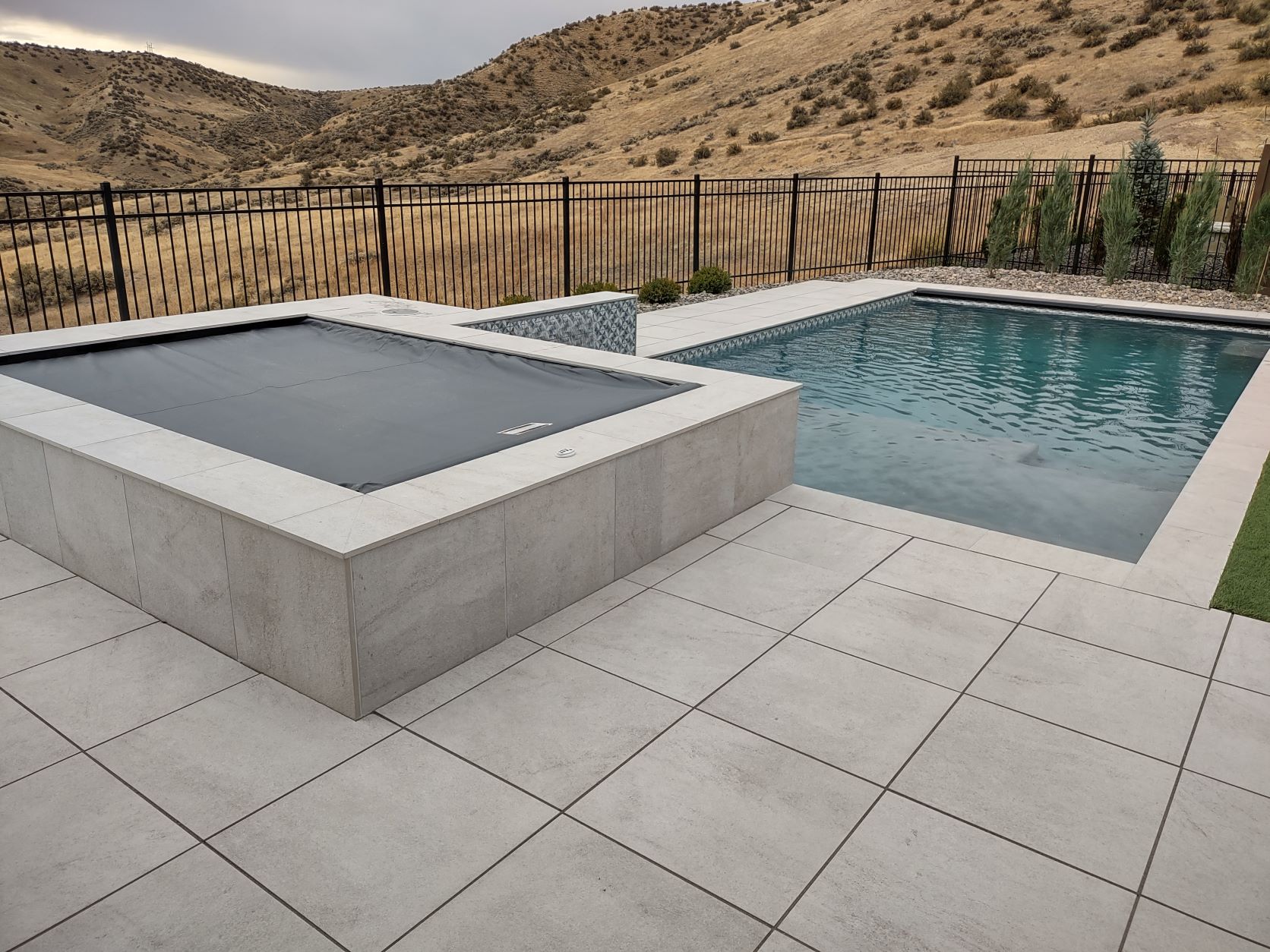
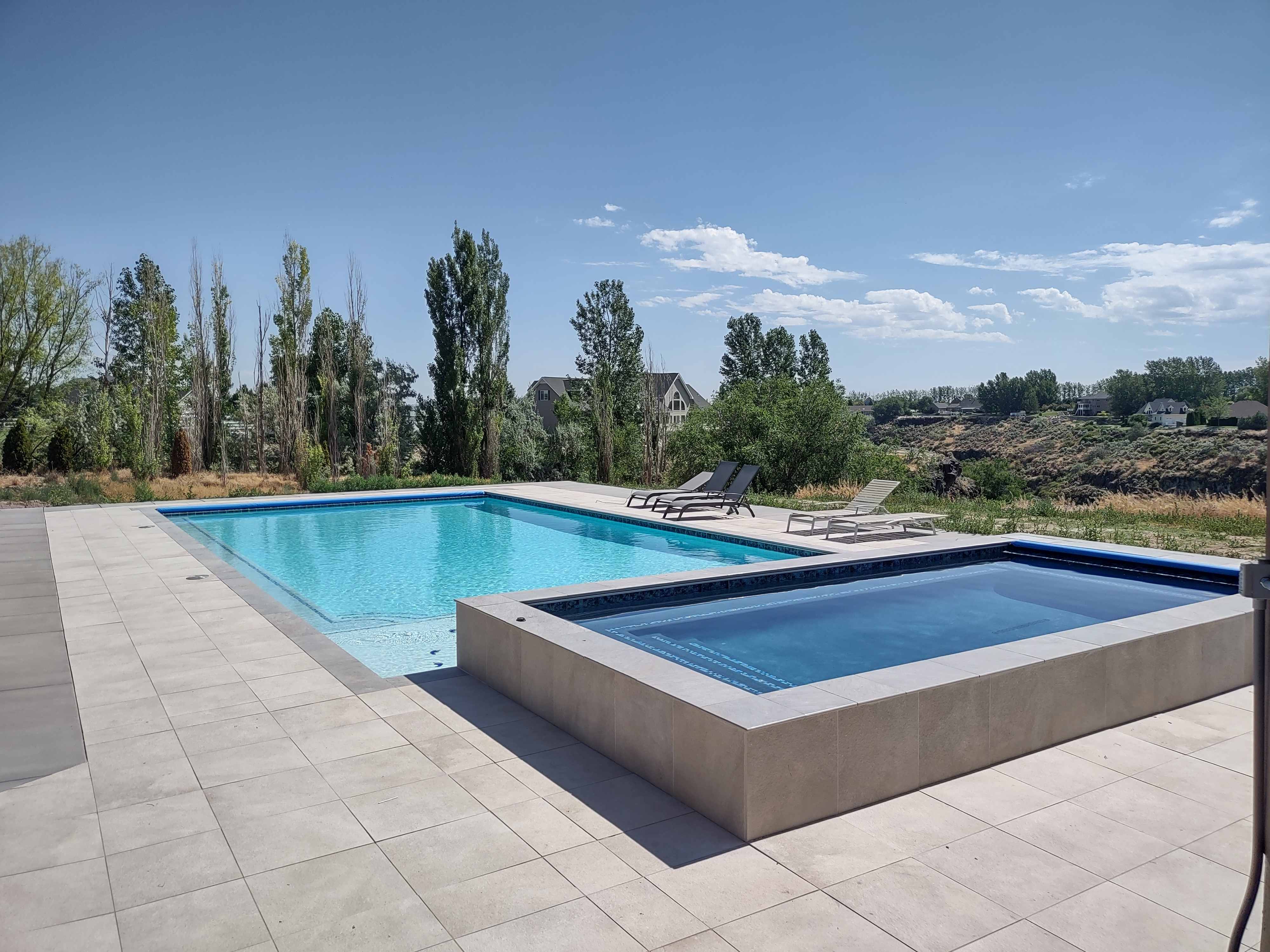
Absolutely — pool and spa combinations are among our most popular builds across Boise, Meridian, Eagle, and Treasure Valley. We build fully integrated gunite spas that share plumbing, filtration equipment, and water chemistry with the main pool for a seamless look and lower equipment cost. We also build elevated standalone spas with spillover water features that cascade into the pool below.
Both configurations are built in gunite, the same as the pool, so everything ages consistently and holds up equally well through Idaho winters.
Water features add visual appeal, a relaxing ambient sound, and better water aeration. Options we incorporate into pool designs across Boise and Treasure Valley include:
Spillover spas — an elevated spa that overflows into the pool below. Sheer descent waterfalls — a thin, clear curtain of water falling from a raised wall or ledge. Deck jets — arching streams of water from the deck into the pool. Bubblers — small fountains on a sun shelf or shallow area. Natural rock grottos — stone waterfall features that create a more naturalistic look.
Water features are designed into the pool during the planning stage — they're not typically added after the fact. We'll help you choose features that suit your backyard's scale and your aesthetic goals.
The interior finish of a gunite pool can be applied in several materials, each with different durability, maintenance, and aesthetic characteristics:
Plaster — the traditional white or colored finish. Smooth feel, lower upfront cost. Typically needs resurfacing every 8–15 years depending on water chemistry and care.
Quartz aggregate — ground quartz mixed into the plaster. More durable and stain-resistant than standard plaster, with a slight texture. Good balance of cost and longevity for Idaho pools.
Pebble aggregate (e.g. Pebble Tec) — small natural pebbles throughout the surface. Very durable, excellent stain resistance, distinctive texture and appearance. Longest-lasting option available.
Tile — full-tile interiors are the most luxurious and most durable option, but also the highest cost. Very commonly used for spas and waterline tile on all pool types.
Cary stays current on the latest finishing products and techniques, specifically with Idaho's climate durability in mind. We'll guide you to the finish that makes the most sense for your project.
A lot depends on the pool itself, your environment, and how well you maintain it. A well-built pool with quality equipment and proper water chemistry will cost significantly less to maintain and repair over its lifetime than a lower-quality build or one that's been neglected.
Free-form pool shapes are generally more difficult and expensive to cover — and in Idaho, a cover is one of the most impactful cost-reduction tools available. Rectangular pools are more compatible with automatic covers and typically cost less to maintain. Pools with more features (water features, heaters, automation) have more equipment that can eventually need service.
Like anything you own, a pool needs regular maintenance, proper winterization, and adequate insurance. Treating it well extends the life of the finish and equipment significantly.
A pool cover is one of the smartest investments you can make for an Idaho pool. The benefits are significant: heat retention (a covered pool loses dramatically less heat overnight and between uses), chemical savings (evaporation is the primary source of water and chemical loss), debris exclusion (keeps leaves, dust, and cottonwood out), and safety (an automatic cover provides a true physical barrier across the water surface).
In Idaho's climate, where pool seasons can be shorter and heating costs higher, a cover often pays for itself within just a few seasons in energy and chemical savings. We install electric automatic covers and highly recommend them to every pool owner we work with.
A properly built gunite pool — engineered correctly for Idaho's soils and climate, and maintained well — can last 50+ years. The shell itself, if built right, should never need full replacement. The interior finish (plaster, quartz, or pebble) will need resurfacing periodically — typically every 8–20 years depending on the finish type and water chemistry maintenance. Equipment like pumps, heaters, and filters have their own lifespans but are all serviceable and replaceable.
This is one of the primary reasons we build exclusively in gunite and shotcrete. It's the only pool type that can realistically last a lifetime with proper care.
Pool safety is something we take seriously on every build. The most important features we recommend:
Automatic pool cover — the single most effective safety barrier available. A properly installed automatic cover can support the weight of an adult and prevents unsupervised access to the water. It also keeps the pool cleaner and dramatically reduces operating costs.
Perimeter fencing — required by most cities in Boise, Meridian, Nampa, and Treasure Valley. Must include self-closing, self-latching gates. We build pools compliant with all applicable local fencing codes.
Anti-entrapment drain covers — required by federal law (Virginia Graeme Baker Act) on all pools. These prevent suction entrapment at the main drain.
Depth markers — permanently installed at all depth changes around the pool perimeter.
Lighting — proper pool lighting for visibility after dark. LED pool lights are energy-efficient, long-lasting, and also serve an important safety function.
We'll walk you through all Idaho code requirements and manufacturer safety recommendations during your design consultation.
Diving boards have become much less common in residential pools over the past two decades, for a few reasons. A proper diving pool requires very specific dimensions — with a large, deep end that takes up roughly 75% of the pool — which significantly limits the usable swimming area for the rest of the family. Homeowner's insurance premiums can also be affected by diving boards.
Most Boise and Treasure Valley families today prefer a sports pool depth profile, which offers usable depth across the whole pool while still being appropriate for jumping and recreational use. We'll be honest with you about what makes the most sense for your family and your backyard.

We don't want to be Idaho's premier pool company — we want to be your premier pool company. Call or text us, and let's talk about your backyard.